What is a PaaS?
Small teams can ship to production without hiring dedicated DevOps engineers.
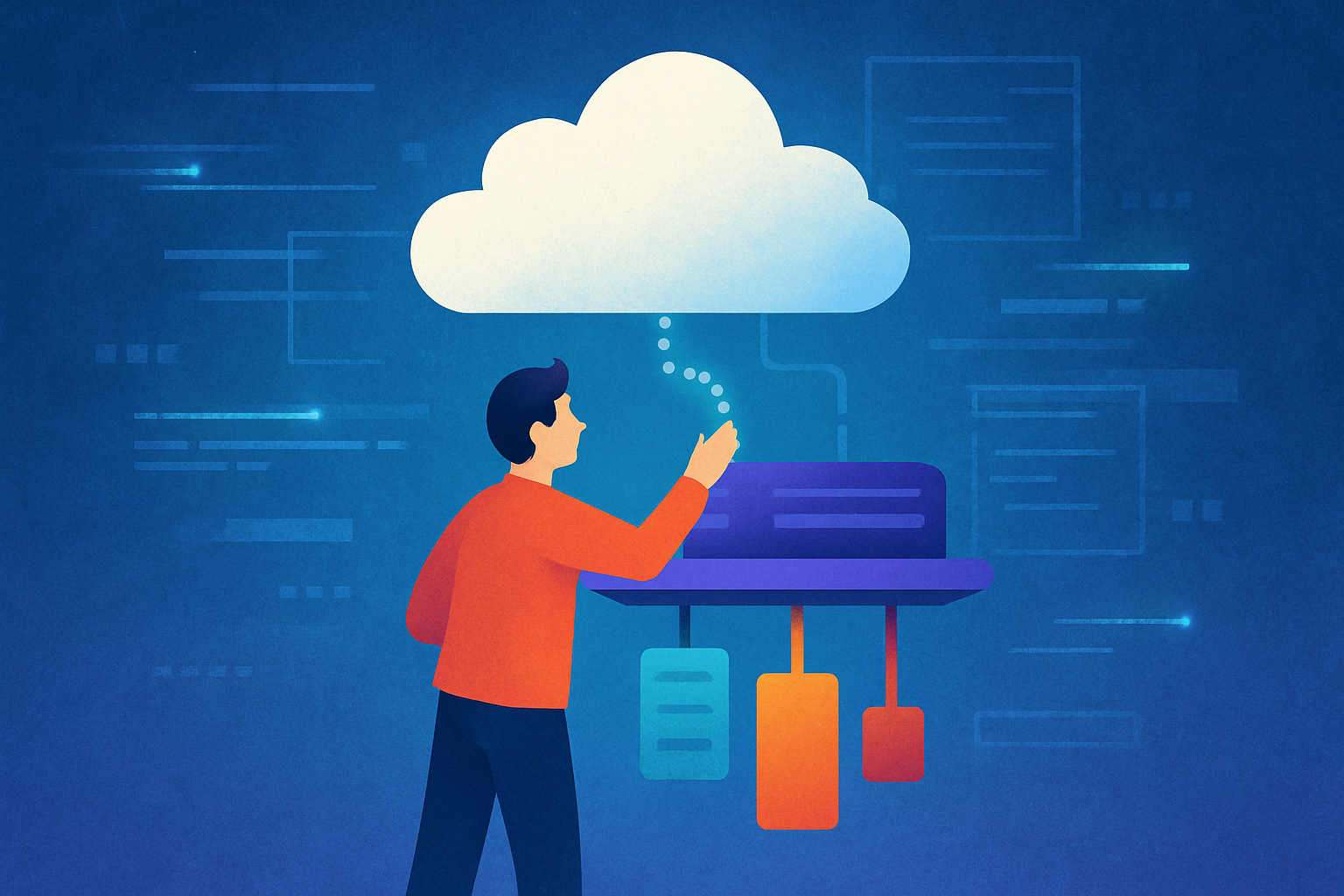
The easiest way to appreciate what PaaS actually does is to enumerate what stops being your problem the moment you adopt one. Not abstractly. Concretely, line by line.
Auto-scaling: when traffic spikes, the platform spins up new instances and reallocates resources, routing requests through built-in load balancers the whole time. No manual configuration. No 2 a.m. alert because a deployment saturated a single node. The platform watches the traffic signal; the developer watches nothing.
Patching is gone too. OS updates, runtime version bumps, CVE remediation across the underlying cluster: all of it belongs to the provider. Your engineering team will never schedule a maintenance window to apply a kernel patch to a production node, because those nodes are not yours to patch. I've seen teams spend entire sprints on this work before adopting a platform. Afterward, they couldn't remember why they'd tolerated it.
CI/CD disappears as a project entirely. Push to GitHub or GitLab and the platform triggers a build, runs your tests, and deploys, with zero-downtime rollouts, no deployment script required. No YAML to author, version, and eventually resent.
The cumulative effect is this: a small team, five engineers focused on product, can ship to production without a dedicated DevOps hire. What remains explicitly the developer's job is application logic, data modeling, and feature decisions. That boundary is the whole point. The contract is precise.
Where PaaS sits in the broader cloud model and why the middle layer matters
Infrastructure as a Service gives you raw building blocks: compute, storage, networking. Software as a Service gives you finished software you can consume but cannot meaningfully modify beneath the feature layer. PaaS is the construction environment between them — if IaaS is a plot of land and SaaS is a furnished apartment, PaaS is the fully framed house where you still choose every fixture.
A team operating on pure IaaS still writes Terraform, manages Kubernetes, and patches nodes. The full DevOps surface remains theirs. A team on SaaS runs someone else's application. PaaS is the layer where you retain full authorial control over what you build while shedding the infrastructure surface you'd otherwise need specialists to operate.
This positioning explains something pure market analysis obscures. PaaS adoption tracks closely with the growth of small, product-focused engineering teams, not primarily because those teams are cost-constrained (though they are), but because the middle layer is the only one that lets them behave like a larger organization without staffing like one. They get the deployment environment of a company that has a platform engineering team, without having hired one. That asymmetry is the actual value proposition, and it doesn't get stated plainly enough.
How big the PaaS market has grown and what that signals about developer demand
The global PaaS market exceeded $176 billion in 2024, according to Statista. IDC projected a compound annual growth rate of 28.8% for the cloud and PaaS market from 2021 through 2025. The acceleration of generative AI has added another growth driver on top of traditional web application hosting, expanding the addressable use case rather than simply redistributing existing demand.
What those figures actually communicate is simpler than the analysts make it sound: the contract PaaS offers is one developers keep choosing, repeatedly, across industries and team sizes. Structural demand, not a hype cycle. The consistency of that choice, sustained across years and market conditions, is more revealing than any single revenue figure.
The common variants of PaaS and the scenarios each one fits
Not all PaaS offerings implement the contract identically. The responsibility split stays consistent; tenancy model and deployment target vary considerably.
Public PaaS is the canonical form. The provider manages the full infrastructure layer, the developer gets a shared environment running on the provider's cloud, and the appeal is maximum simplicity. Heroku, Render, and Railway are representative examples. The obvious tradeoff is that the underlying infrastructure is shared with other customers.
Private PaaS maintains the same division of responsibilities but deploys the platform inside a company's own cloud account or data center. Compliance-sensitive teams running workloads that cannot coexist with unknown neighbors use this model, often because their legal or security team stopped the conversation before it reached engineering.
Kubernetes-based PaaS wraps Kubernetes in a developer-friendly abstraction and deploys into the customer's own AWS, GCP, or Azure account. It combines the ergonomic simplicity developers expect from PaaS with the tenancy control that enterprise infrastructure requires. This is where a lot of growth-stage companies end up.
Serverless PaaS allocates compute only when a request arrives, no persistent instances to manage or pay for at rest. Vercel embodies this for frontend workloads; Modal has extended it to GPU-intensive computation, which is a more significant extension than it sounds.
The variant worth choosing depends on what a team optimizes for: speed of initial setup, compliance posture, cost predictability, or control over the underlying cloud account. The fine print differs. The core contract does not.
The tradeoffs teams accept when they adopt a shared-tenant PaaS
Shared-tenant PaaS comes with documented disadvantages that practitioners have catalogued over years of real production use: pricing that compounds expensively at scale, reduced operational visibility, limits on traffic routing customization, and a compliance ceiling that stops short of what enterprise buyers typically require.
The noisy-neighbor problem is genuine. Shared infrastructure means your application's performance can be affected by what other tenants are doing on the same cluster, with no visibility into the underlying environment to diagnose it. You can see the symptom; you cannot reach the cause. It's a bit like hearing a leak in the walls of an apartment you're renting — you know something is wrong, but the pipes aren't yours to touch.
Vendor lock-in deserves direct treatment because it rarely announces itself. The easier the onboarding, the harder the exit. Proprietary build systems, managed database integrations, and platform-specific environment configurations accumulate quietly over months. By the time the lock-in is apparent, untangling it has become its own project, usually an unwelcome one surfacing during a migration that was supposed to be straightforward.
Heroku's 30-second request timeout and enforced daily dyno restarts are concrete historical examples of the category of friction that emerges as applications mature. These are real engineering constraints that force architectural decisions a developer would otherwise never need to make. They're not bugs in the platform; they're load-bearing parts of its design, which makes them harder to work around.
These tradeoffs don't disqualify the shared-tenant model. They locate, with reasonable precision, the point at which the standard contract stops fitting a team's actual situation.
What changes when a PaaS deploys into a team's own cloud account
When the platform manages the same infrastructure surface, cluster provisioning, networking, autoscaling, patching, but does so inside the customer's own AWS, GCP, or Azure account, several things change at once.
Compliance posture changes materially. SOC 2 and HIPAA controls can now span the full stack because the team owns the environment rather than relying on a shared provider's certification covering only their slice of a multi-tenant system. The audit trail is yours. The data residency controls are yours. For companies in regulated industries or pursuing enterprise sales, this distinction is frequently the one that determines whether a deal closes.
Cost structure shifts as well. Infrastructure costs flow through the team's own cloud bill, where committed-use discounts and reserved instance pricing become available. The markup embedded in a shared-tenant platform's fixed pricing disappears.
The developer experience contract stays intact throughout. Push code; the platform handles deployment. That interaction is unchanged. The tenancy model underneath is fundamentally different, and the downstream consequences of that difference compound significantly as a company moves from early product to enterprise sales cycles. This is the upgrade path that matters, not a migration away from PaaS, but a migration to a version of the same contract with better terms at a different stage.
How PaaS handles CI/CD and why that integration is central to the model
Connect a Git repository and every push triggers the platform's build, test, and deploy sequence. No pipeline YAML required on day one. That is a meaningful elimination of an entire class of engineering work that teams on IaaS treat as foundational infrastructure. It's not a convenience feature; it's the mechanism by which the platform actually enforces its half of the contract.
Automated preview environments for pull requests, rollback on failed health checks, zero-downtime deployments: these are platform responsibilities in the PaaS model, not capabilities a team assembles from primitives on a quarterly roadmap.
The DevSecOps extension follows naturally from this. CI/CD gates can enforce compliance checks before code reaches production, and automated deployment logs satisfy a material portion of SOC 2 evidence requirements without additional tooling or process overhead.
For a five-person team, the practical meaning is direct: one developer can ship on a Friday afternoon without a release manager, a deployment runbook, or an on-call rotation standing by. Remove CI/CD from the PaaS model and the platform cannot deliver on its core promise. It is not ancillary to the model; it is the model.
Where GPU workloads and AI inference fit into the PaaS responsibility model
Training and inference have distinct infrastructure profiles that get conflated often enough to be worth separating. Training requires fault-tolerant distributed compute that can survive node failures across a long-running job. Inference, which now accounts for the majority of enterprise GPU spend, requires low-latency, auto-scaling, cost-per-request efficiency. Different problems, different infrastructure, frequently purchased by teams who haven't fully distinguished between them yet.
A PaaS for AI workloads takes on GPU provisioning, scheduling, and scaling. The developer owns the model and the inference logic. The platform owns the cluster. The contract is structurally identical to the web application case; the compute underneath is more expensive, more specialized, and considerably harder to operate without platform abstraction.
Modal's May 2026 Series C, $355 million at a $4.65 billion valuation, more than four times its valuation from September 2025, is a market signal worth reading plainly. Serverless GPU infrastructure is where developer demand is concentrating. The underlying contract between developer and platform is unchanged; the workload it now covers has expanded significantly.
When PaaS is the right call and when teams typically outgrow a given tier
Early-stage teams should use shared-tenant PaaS. It maximizes shipping velocity, minimizes infrastructure decisions, and costs less to operate than any realistic alternative at that stage.
Growth-stage teams hitting compliance requirements, cost cliffs, or operational control limits should read that friction as a signal to move toward a version of the contract where the team owns the cloud account, not as a reason to abandon PaaS entirely. That migration is an upgrade, not a retreat, and the teams that treat it as the latter overcorrect toward raw IaaS and spend the next year rebuilding what the platform was already doing for them.
Heroku's February 2026 shift to a sustaining-engineering posture, no new features planned, is a concrete marker of where the shared-tenant ceiling sits. Teams that built on it are navigating that transition now. The destination is not raw IaaS.
The question is rarely whether to use PaaS. Most teams that think they're evaluating PaaS versus IaaS are actually evaluating which version of the contract fits their current situation and, more importantly, their situation in eighteen months. Get that answer right and the infrastructure decision largely makes itself.